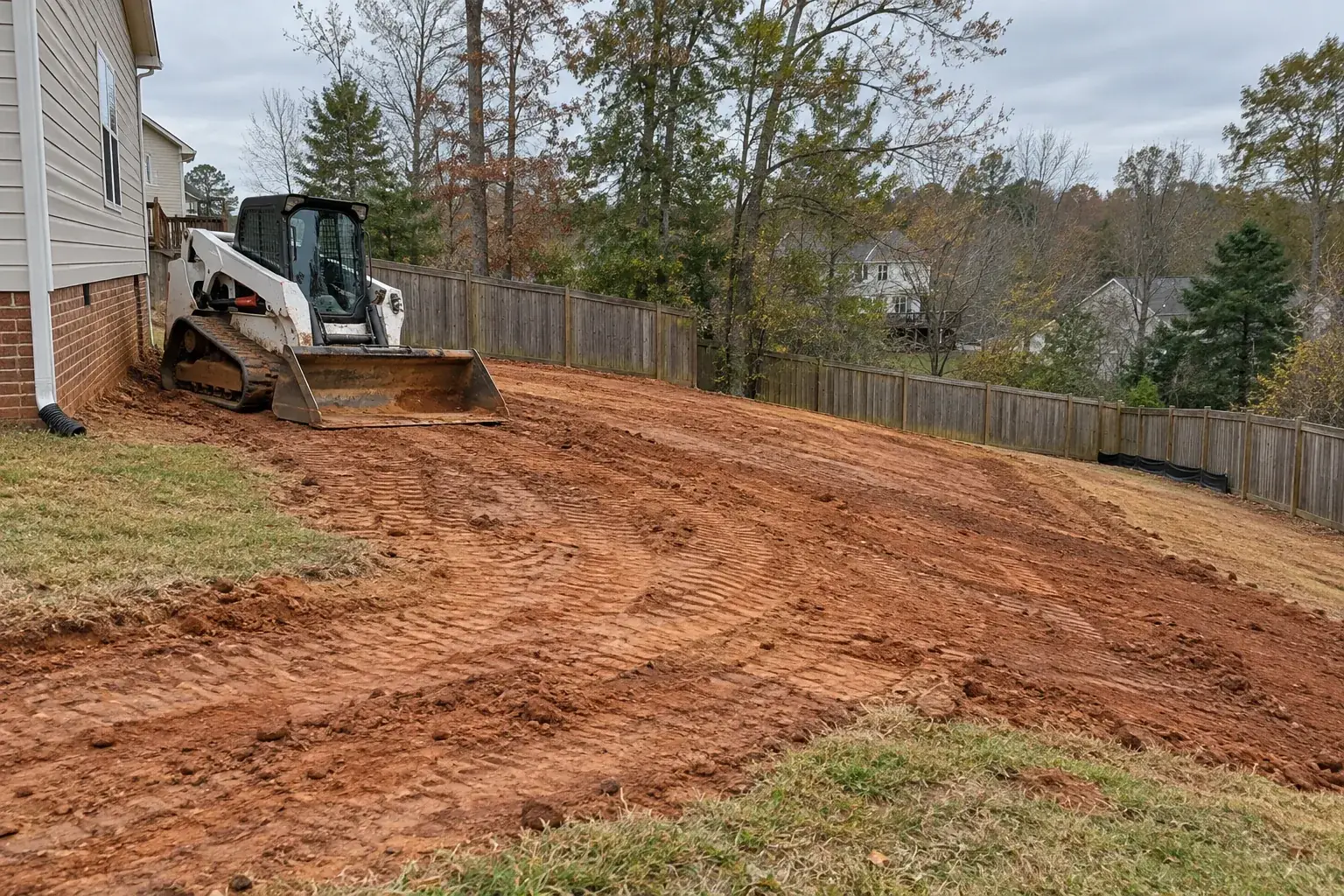
Planning this work at a Anderson property
Anderson yards can show water problems where lawn, planting beds and hard surfaces meet. These edges often redirect runoff or hold it above surrounding soil. Identify whether the water comes from the surface, a roof connection or ground that stays saturated after nearby areas dry.
Take wide photographs from both directions and include the slope beyond the puddle. A close image of water does not reveal where it began. Note erosion, deposited soil and the time required for the area to become usable after rain.
Before work is priced, confirm how the proposed route crosses roots, fences, walkways and existing landscaping. The Anderson estimate should describe excavation, soil handling, outlet construction and the exact restoration area so a low price does not omit necessary finishing work.
What to document before requesting a Anderson estimate
Anderson homeowners may see water gather where lawns, beds and hard surfaces meet. The visible puddle may be downstream from the actual source.
For an Anderson property, include photos of the wider slope and nearby downspouts, not only a close-up of standing water.
At an Anderson property, begin at the edges between lawn, planting beds, patios and driveways. These transitions can reveal where runoff changes direction or becomes trapped. Note whether mulch washes, turf thins or sediment collects, because those signs show the path even when the yard is dry.
Avoid adding soil to a low spot until the next destination for the water is clear. Raising one area can move runoff toward another part of the yard or a nearby structure. Record the available fall, obstacles and possible outlet so grading and drainage options can be compared together. Include any existing drain covers or pipe outlets in the property photos.
When grading may be the right first step
Grading can help when a low area interrupts an otherwise workable surface route, soil has settled beside a structure or runoff moves in the wrong direction across the lawn. It is not simply adding topsoil to a puddle. The new surface must connect to a lower destination, maintain necessary clearances and avoid pushing water toward another vulnerable area.
Measure the whole route
Small elevation differences can determine whether water moves or remains. Measurements should cover the source, the low point, the proposed path and the outlet, not only the visibly wet patch. Patios, driveways, fences, roots and neighboring grades may limit how much soil can be added or removed. Sometimes grading works best with an inlet or pipe at the end.
What affects yard grading cost
The amount of soil moved, disposal or imported material, equipment access, tree roots, hand work, erosion protection and lawn restoration influence the total. A small low-spot correction may begin near the listed starting price; broad reshaping can cost much more. Compare finished elevations and restoration limits, not only equipment hours or cubic yards.
Yard Grading for Drainage in Anderson, SC questions
Can I fill a low spot with topsoil?
Only after confirming where the displaced water will move. Filling without a route can transfer the problem.
Will grading damage the lawn?
Areas being reshaped are normally disturbed and need seed, sod or another specified restoration method.
Can grading move water away from a foundation?
It can correct surface slope when elevations allow, often alongside management of roof runoff.
When is a drain needed with grading?
A drain may be added when surface fall is limited or water must cross an obstacle through a controlled route.
Do I need grading or a drain?
Grading changes the surface path; a drain collects water. Measurements on the property determine which fits.
Can a low spot simply be filled?
Only after checking where water will move next.