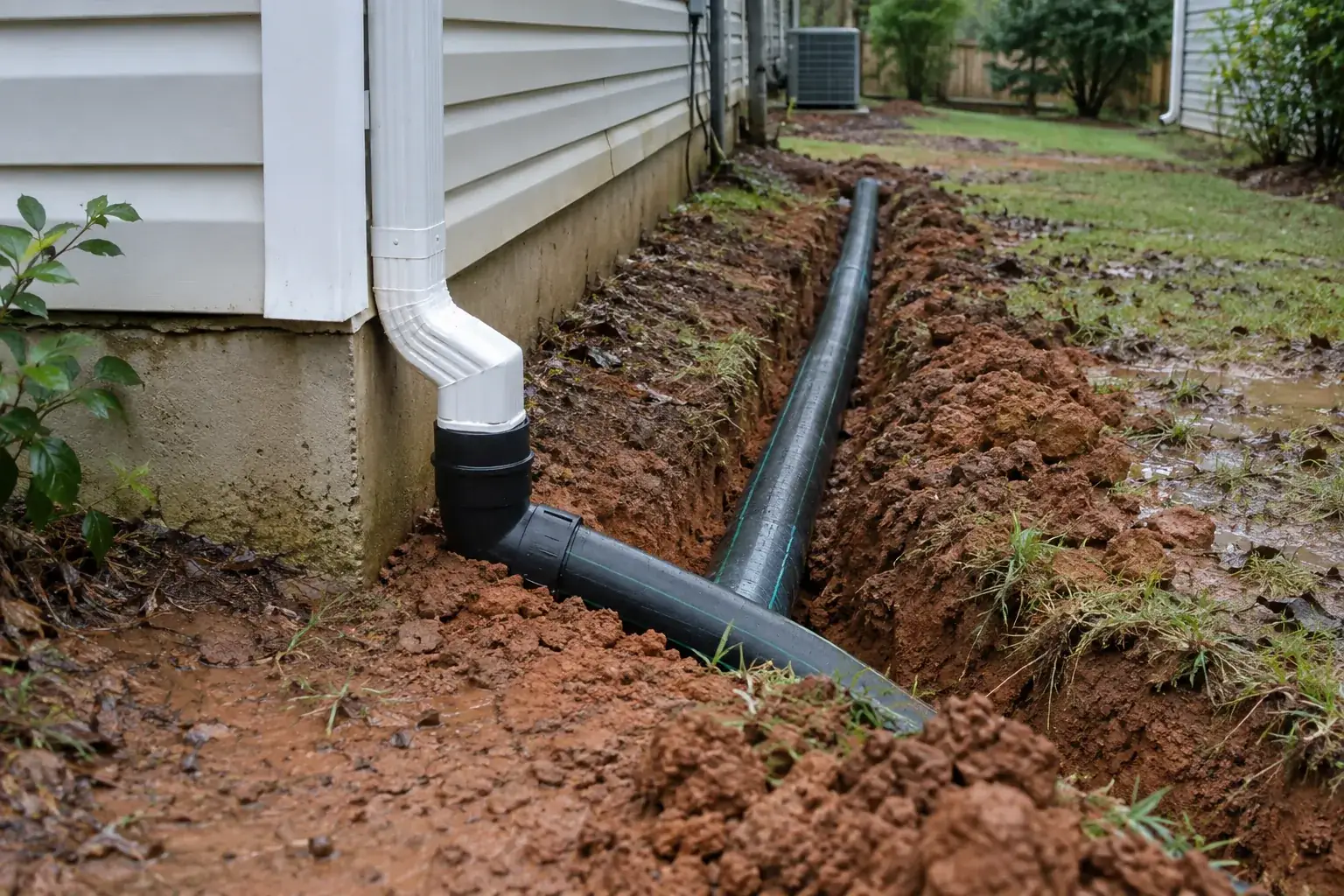
Planning this work at a Fountain Inn property
Fountain Inn yards may collect water beside patios, at low lawn edges or below roof discharge. Compare the pattern during rain with the same area the following day to separate fast surface runoff from soil that remains saturated.
Include nearby hard surfaces, downspouts, existing grates and the wider grade in photographs. Mark whether water reaches a doorway, walkway or foundation edge and whether a visible outlet flows freely. These observations narrow the useful collection options.
A Fountain Inn estimate should identify the source, collection point, route, outlet and restoration. Ask how the system will be cleaned and which features remain visible. Pipe length alone does not account for access, fittings, excavation conditions or final surface repair.
What to document before requesting a Fountain Inn estimate
Fountain Inn homeowners may see ponding in low lawns, water near patios or roof runoff cutting through mulch and turf. The solution depends on how those flows connect.
For a Fountain Inn estimate request, identify the wet area, nearby hard surfaces and how long the ground stays soft after rainfall.
On a Fountain Inn property, compare the wet area during rain with the same area the following day. Water that appears quickly beside a patio or driveway may be surface runoff, while turf that stays soft long afterward can indicate slow drainage or repeated inflow from another source.
Check downspout locations, low lawn edges and any existing pipe or grate. Record whether the outlet is visible and clear. When reviewing a proposal, confirm the collection method, route, outlet, cleanout or maintenance access, and how lawn or planting areas will be repaired when the drainage work is complete.
Start above the buried pipe
Water spilling beside the house can begin with an undersized gutter, blocked outlet, loose elbow or poor connection. Those items should be checked before assuming the underground route is the only problem. During rain, note whether the gutter overflows, the downspout backs up or water escapes only after it reaches the ground. Each pattern points to a different repair.
Use solid pipe for roof runoff
A downspout carries concentrated water, so the buried route normally uses solid pipe rather than perforated French-drain pipe. Solid pipe keeps roof water contained until it reaches the intended outlet. Connections should be serviceable, and changes in direction should be limited or made with fittings that reduce blockage risk. The inlet should not trap leaves without a practical way to clean it.
What affects downspout drainage cost
The starting range fits a short, accessible run with a simple outlet. Cost rises with additional downspouts, longer pipe, deeper excavation, concrete or walkway crossings, root conflicts and restoration. A useful estimate lists how many downspouts connect, pipe type and diameter, route length, cleanout access, outlet construction and the surfaces that will be repaired.
Downspout Drainage Installation in Fountain Inn, SC questions
Can several downspouts share one pipe?
Sometimes, when the pipe capacity, slope and outlet are designed for the combined roof flow.
Why does a buried downspout back up?
Common reasons include debris, crushed or separated pipe, insufficient fall, a blocked outlet or too much flow for the route.
Should downspout pipe have holes?
The main roof-water route is generally solid so concentrated runoff stays contained until discharge.
How far should water be carried?
Distance alone is not the answer. The route should reach a workable outlet with sufficient fall and no new impact on structures or neighboring property.
Can a catch basin solve a low spot?
A catch basin can collect surface water at a defined low point when there is a suitable pipe route and outlet.
What changes the cost of drainage work?
Length, excavation depth, access, surface restoration and outlet construction are common cost factors.