Planning this work at a Fountain Inn property
Fountain Inn yards may collect water beside patios, at low lawn edges or below roof discharge. Compare the pattern during rain with the same area the following day to separate fast surface runoff from soil that remains saturated.
Include nearby hard surfaces, downspouts, existing grates and the wider grade in photographs. Mark whether water reaches a doorway, walkway or foundation edge and whether a visible outlet flows freely. These observations narrow the useful collection options.
A Fountain Inn estimate should identify the source, collection point, route, outlet and restoration. Ask how the system will be cleaned and which features remain visible. Pipe length alone does not account for access, fittings, excavation conditions or final surface repair.
What to document before requesting a Fountain Inn estimate
Fountain Inn homeowners may see ponding in low lawns, water near patios or roof runoff cutting through mulch and turf. The solution depends on how those flows connect.
For a Fountain Inn estimate request, identify the wet area, nearby hard surfaces and how long the ground stays soft after rainfall.
On a Fountain Inn property, compare the wet area during rain with the same area the following day. Water that appears quickly beside a patio or driveway may be surface runoff, while turf that stays soft long afterward can indicate slow drainage or repeated inflow from another source.
Check downspout locations, low lawn edges and any existing pipe or grate. Record whether the outlet is visible and clear. When reviewing a proposal, confirm the collection method, route, outlet, cleanout or maintenance access, and how lawn or planting areas will be repaired when the drainage work is complete.
Trace water before cutting concrete
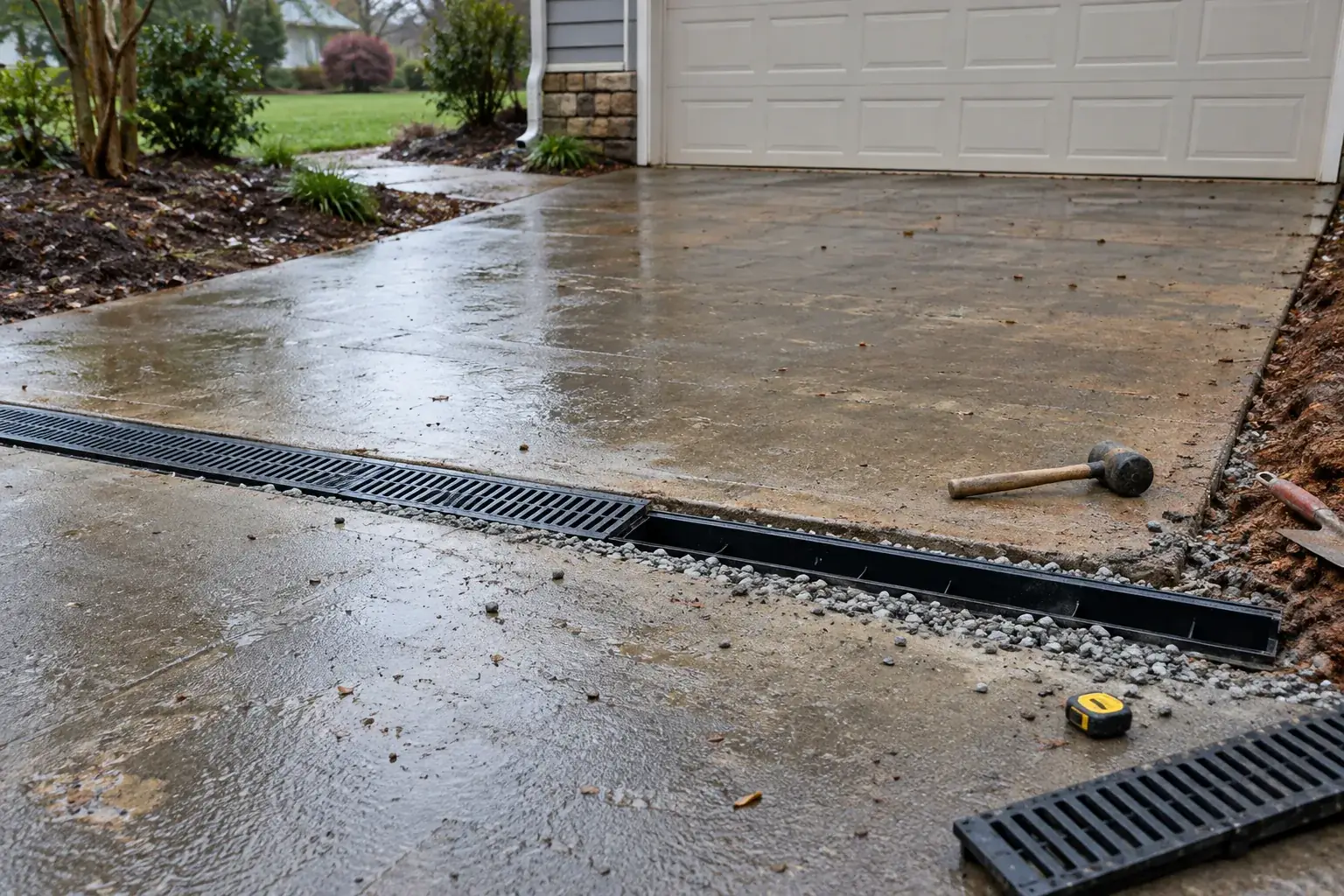
A channel drain can intercept water crossing a driveway, but it should not be selected before the upstream source is understood. Runoff may arrive from the street, an uphill lawn, roof discharge or the driveway surface itself. Redirecting some water before it reaches the pavement can reduce the required drain size and simplify the outlet route.
Channel drains and point inlets solve different patterns
A linear channel drain collects water along an edge or across a broad paved path. A catch basin handles flow that gathers at a defined low point. Some driveways need both collection and grade correction. The proposed grate, channel strength and placement should match vehicle loading and sit at an elevation that actually receives the flow.
What affects driveway drainage cost
Driveway systems often start higher than simple lawn drainage because hard-surface work is involved. Channel length, grate load rating, concrete thickness, outlet distance, pipe depth and matching the repaired finish all affect cost. An estimate should state the drain dimensions, outlet route, concrete limits and whether disposal and final cleanup are included.
Driveway Drainage Contractor in Fountain Inn, SC questions
Will a channel drain stop water from entering my garage?
It can intercept correctly directed surface flow, but capacity, placement, driveway grade and the outlet all have to work together.
Can a drain be added without replacing the driveway?
Often a narrow section can be cut and restored, depending on the concrete condition and required route.
What kind of grate is used?
The grate should match the location and expected vehicle loading, and it should be removable for cleaning.
Why is my driveway drain overflowing?
Debris, a blocked outlet, poor slope or more incoming water than the system can carry are common causes.
Can a catch basin solve a low spot?
A catch basin can collect surface water at a defined low point when there is a suitable pipe route and outlet.
What changes the cost of drainage work?
Length, excavation depth, access, surface restoration and outlet construction are common cost factors.