Planning this work at a Fountain Inn property
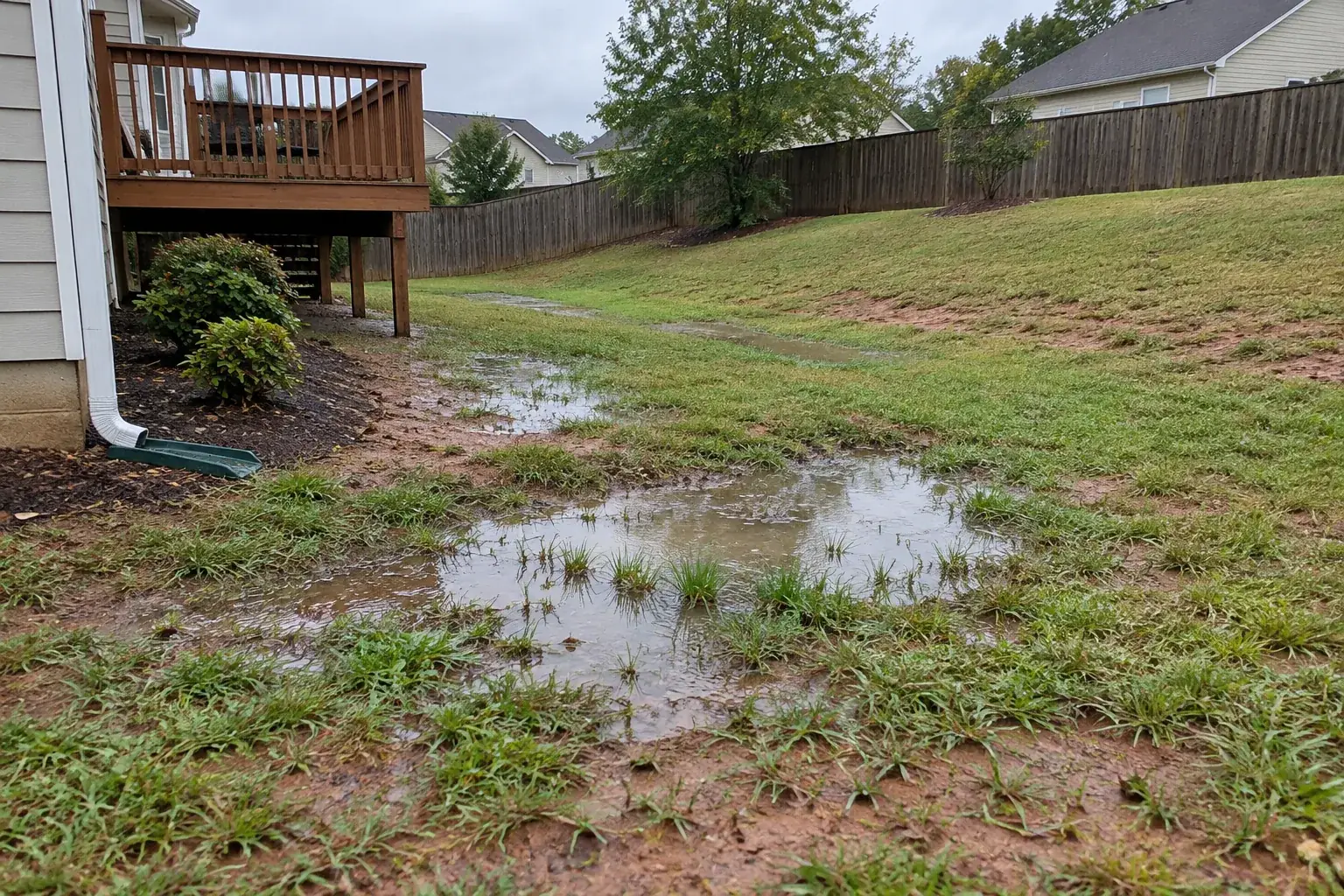
Fountain Inn yards may collect water beside patios, at low lawn edges or below roof discharge. Compare the pattern during rain with the same area the following day to separate fast surface runoff from soil that remains saturated.
Include nearby hard surfaces, downspouts, existing grates and the wider grade in photographs. Mark whether water reaches a doorway, walkway or foundation edge and whether a visible outlet flows freely. These observations narrow the useful collection options.
A Fountain Inn estimate should identify the source, collection point, route, outlet and restoration. Ask how the system will be cleaned and which features remain visible. Pipe length alone does not account for access, fittings, excavation conditions or final surface repair.
What to document before requesting a Fountain Inn estimate
Fountain Inn homeowners may see ponding in low lawns, water near patios or roof runoff cutting through mulch and turf. The solution depends on how those flows connect.
For a Fountain Inn estimate request, identify the wet area, nearby hard surfaces and how long the ground stays soft after rainfall.
On a Fountain Inn property, compare the wet area during rain with the same area the following day. Water that appears quickly beside a patio or driveway may be surface runoff, while turf that stays soft long afterward can indicate slow drainage or repeated inflow from another source.
Check downspout locations, low lawn edges and any existing pipe or grate. Record whether the outlet is visible and clear. When reviewing a proposal, confirm the collection method, route, outlet, cleanout or maintenance access, and how lawn or planting areas will be repaired when the drainage work is complete.
Record when the water appears
Water that forms quickly during rain may be arriving across the surface from a roof, paved area or higher ground. A strip that becomes wet slowly and remains soft can indicate subsurface movement or slow-draining soil. Take photos during rain only from a safe place, then return after several hours to record what dries first and what stays wet.
Find the source beyond the puddle
The lowest point is where water stops, not necessarily where the problem begins. Check downspouts, roof valleys, neighboring slopes, driveway edges and recent landscaping. Sediment, flattened grass and washed mulch can reveal the direction after water disappears. A proposal should connect the chosen collection method to the source rather than treating every puddle as the same condition.
What affects the cost of fixing standing water
There is no single standing-water price because the symptom can lead to different scopes. Cost depends on collection points, route length, excavation, access, outlet construction and restoration. The listed amount is a planning starting point for a straightforward drainage run. A written estimate should state the cause being addressed and what result the proposed work is designed to produce.
Standing Water Yard Service in Fountain Inn, SC questions
Does standing water always mean clay soil?
No. Soil can contribute, but low grade, concentrated runoff, a blocked route or a failed pipe may be more important.
Will a French drain remove every puddle?
Not necessarily. French drains collect water moving through soil; surface puddles may need grading or an inlet.
How long should I observe the area?
Record at least one representative rain event and how the area changes during the following hours.
Can drainage work be done without damaging the lawn?
Some disturbance is normal. The route and restoration method should be defined before work begins.
Can a catch basin solve a low spot?
A catch basin can collect surface water at a defined low point when there is a suitable pipe route and outlet.
What changes the cost of drainage work?
Length, excavation depth, access, surface restoration and outlet construction are common cost factors.